April 15, 2026

Senior Profile 2026: Lloyd Graves IV

No items found.

Lloyd Graves IV didn’t arrive at NuVu because school was working—he arrived because it wasn’t.

For years, he had been navigating systems that never quite fit. Early on, that meant struggling in an under-resourced school district where his dyslexia went unsupported. Later, it meant landing in more structured environments where he could succeed academically, but still felt disconnected from what he was actually learning. “I just felt like I was going through school and spending time there,” he says. “I wasn’t really retaining anything.”

So he stepped away. After spending many summers at Parts and Crafts camp—an environment built around exploration and hands-on learning—Lloyd knew one thing for certain: he wasn’t going back to a traditional path that didn’t work for him. When he heard about NuVu, it wasn’t the result of an exhaustive search. It was simply something different enough to try.

That openness turned into four years.

What Lloyd found at NuVu wasn’t a perfect system. In fact, he’s quick to point out that it isn’t one. But what it offered was something he hadn’t experienced before: the expectation that students don’t just participate in their education—they shape it.

“If there’s anything that’s special about NuVu,” he says, “it’s the environment it provides for students to learn how to learn.”

For Lloyd, that didn’t mean everything came easily. In many ways, it meant the opposite. The freedom to direct his own work, to navigate ambiguity, and to collaborate across different personalities and skill levels created challenges he hadn’t encountered before. Rather than disengaging, he leaned into those challenges—often by building something new.

Photos courtesy of Ken Richardson photography

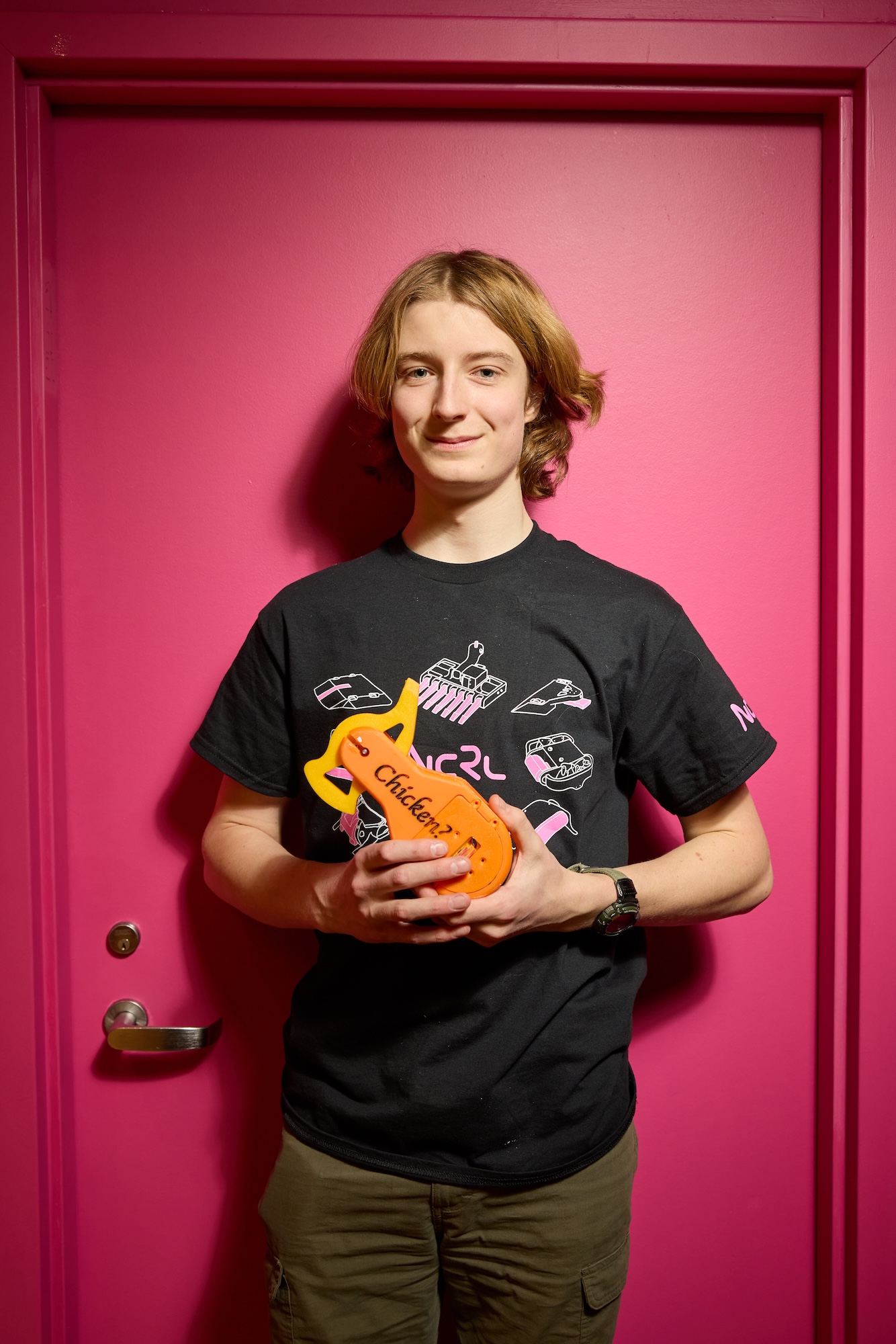
One of the clearest examples of that mindset is the NuVu Combat Robotics Club. Lloyd didn’t set out to start a club for the sake of it. He noticed something he felt was missing—a sense of connection across the student body—and decided to create a space that could bring people together around a shared interest.

What followed was months of persistence. Funding was uncertain. Resources were limited. Progress rarely followed a straight line. Lloyd found himself negotiating for materials, repurposing leftover studio budgets, and finding creative ways to move forward when support wasn’t immediate. At one point, after a frustrating round of conversations about funding, he discovered that many of the materials he needed were already available—cut to the exact specifications he had designed. It was an unexpected moment of alignment that helped push the project forward.

Eventually, the club took shape. A functioning combat robotics cage. Competitions that drew attention. A space where students across grades could gather, build, and engage with one another. “I do feel really proud of that,” Lloyd says, reflecting on what he created.

More importantly, he built something that could continue beyond him—a structure others could pick up and carry forward.

That same approach shows up in Lloyd’s studio work, where his projects consistently focus on rethinking systems and making them more accessible or efficient. His Capstone project, for example, tackles a complex and often overlooked challenge: navigation for blind users. Rather than designing a high-tech solution dependent on extensive infrastructure, Lloyd focused on the experience of the user. His proposed system allows individuals to record and retrace meaningful environmental cues—sounds, textures, and spatial markers—making navigation more personal, flexible, and accessible.

Other projects reflect a similar mindset. In EcoSort, he worked to design a waste-sorting system that addresses recycling issues at their source, particularly in educational environments. In Pasta Recovery, he and his collaborators explored a low-cost method for recycling 3D printing material, using simple tools to replicate the function of far more expensive machinery.

Across these projects, there is a consistent throughline: a focus on practical problem-solving, a willingness to question existing approaches, and a drive to build solutions that actually work in the real world.

Lloyd is also candid about the reality of his experience. Not everything at NuVu aligned with his expectations, and not every challenge was resolved. But that tension became part of the learning process. He developed the ability to advocate for his ideas, to navigate systems that weren’t always straightforward, and to continue building even when conditions weren’t ideal.

That resilience—combined with a deep curiosity about how things work and how they can be improved—has shaped his path forward.

After graduation, Lloyd will attend Olin College of Engineering, where he plans to continue exploring and building. One of his first goals is already familiar: creating a combat robotics club. This time, he’ll bring with him the experience of having built something from the ground up—the challenges, the workarounds, and the understanding of what it takes to turn an idea into something real.

At NuVu, Lloyd didn’t just complete projects. He tested systems, pushed against limitations, and built anyway.

April 15, 2026

Senior Profile 2026: Lloyd Graves IV

When School Doesn’t Fit, Build Your Own Path
Lloyd Graves IV didn’t arrive at NuVu because school was working—he arrived because it wasn’t.

For years, he had been navigating systems that never quite fit. Early on, that meant struggling in an under-resourced school district where his dyslexia went unsupported. Later, it meant landing in more structured environments where he could succeed academically, but still felt disconnected from what he was actually learning. “I just felt like I was going through school and spending time there,” he says. “I wasn’t really retaining anything.”

So he stepped away. After spending many summers at Parts and Crafts camp—an environment built around exploration and hands-on learning—Lloyd knew one thing for certain: he wasn’t going back to a traditional path that didn’t work for him. When he heard about NuVu, it wasn’t the result of an exhaustive search. It was simply something different enough to try.

That openness turned into four years.

What Lloyd found at NuVu wasn’t a perfect system. In fact, he’s quick to point out that it isn’t one. But what it offered was something he hadn’t experienced before: the expectation that students don’t just participate in their education—they shape it.

“If there’s anything that’s special about NuVu,” he says, “it’s the environment it provides for students to learn how to learn.”

For Lloyd, that didn’t mean everything came easily. In many ways, it meant the opposite. The freedom to direct his own work, to navigate ambiguity, and to collaborate across different personalities and skill levels created challenges he hadn’t encountered before. Rather than disengaging, he leaned into those challenges—often by building something new.

Photos courtesy of Ken Richardson photography

One of the clearest examples of that mindset is the NuVu Combat Robotics Club. Lloyd didn’t set out to start a club for the sake of it. He noticed something he felt was missing—a sense of connection across the student body—and decided to create a space that could bring people together around a shared interest.

What followed was months of persistence. Funding was uncertain. Resources were limited. Progress rarely followed a straight line. Lloyd found himself negotiating for materials, repurposing leftover studio budgets, and finding creative ways to move forward when support wasn’t immediate. At one point, after a frustrating round of conversations about funding, he discovered that many of the materials he needed were already available—cut to the exact specifications he had designed. It was an unexpected moment of alignment that helped push the project forward.

Eventually, the club took shape. A functioning combat robotics cage. Competitions that drew attention. A space where students across grades could gather, build, and engage with one another. “I do feel really proud of that,” Lloyd says, reflecting on what he created.

More importantly, he built something that could continue beyond him—a structure others could pick up and carry forward.

That same approach shows up in Lloyd’s studio work, where his projects consistently focus on rethinking systems and making them more accessible or efficient. His Capstone project, for example, tackles a complex and often overlooked challenge: navigation for blind users. Rather than designing a high-tech solution dependent on extensive infrastructure, Lloyd focused on the experience of the user. His proposed system allows individuals to record and retrace meaningful environmental cues—sounds, textures, and spatial markers—making navigation more personal, flexible, and accessible.

Other projects reflect a similar mindset. In EcoSort, he worked to design a waste-sorting system that addresses recycling issues at their source, particularly in educational environments. In Pasta Recovery, he and his collaborators explored a low-cost method for recycling 3D printing material, using simple tools to replicate the function of far more expensive machinery.

Across these projects, there is a consistent throughline: a focus on practical problem-solving, a willingness to question existing approaches, and a drive to build solutions that actually work in the real world.

Lloyd is also candid about the reality of his experience. Not everything at NuVu aligned with his expectations, and not every challenge was resolved. But that tension became part of the learning process. He developed the ability to advocate for his ideas, to navigate systems that weren’t always straightforward, and to continue building even when conditions weren’t ideal.

That resilience—combined with a deep curiosity about how things work and how they can be improved—has shaped his path forward.

After graduation, Lloyd will attend Olin College of Engineering, where he plans to continue exploring and building. One of his first goals is already familiar: creating a combat robotics club. This time, he’ll bring with him the experience of having built something from the ground up—the challenges, the workarounds, and the understanding of what it takes to turn an idea into something real.

At NuVu, Lloyd didn’t just complete projects. He tested systems, pushed against limitations, and built anyway.

To learn more about joining our school, click this button!
Admission